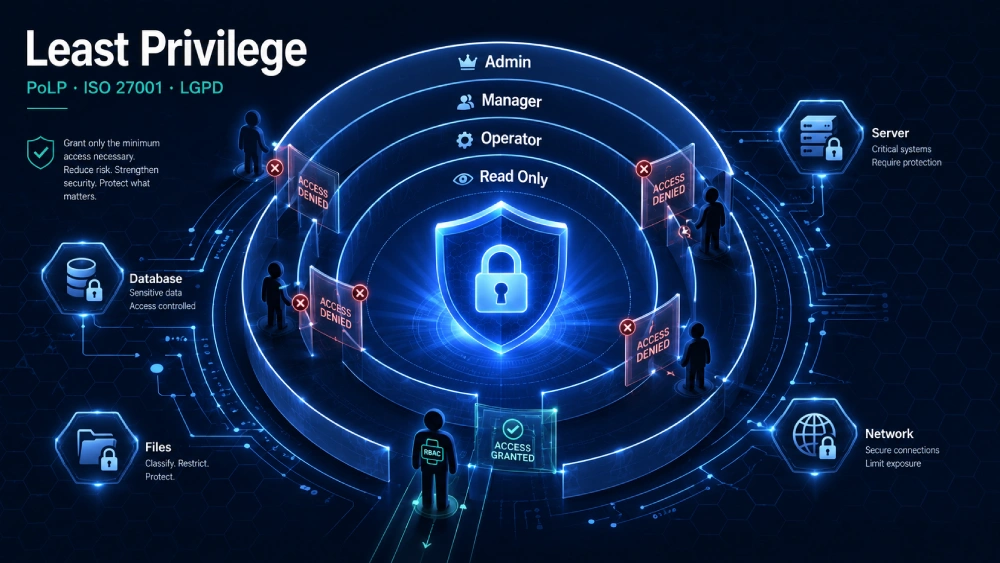

Principle of Least Privilege (PoLP): The Cybersecurity Rule That Limits the Blast Radius of Every Attack
In cybersecurity and compliance, there is one rule that quietly protects organizations more than almost any other: the Principle of Least Privilege (PoLP). Whether you manage servers, databases, cloud infrastructure, or enterprise applications, applying PoLP is one of the most cost-effective and auditor-approved security controls available today. This article explains what PoLP is, where it applies, why it matters for compliance frameworks like ISO 27001 and LGPD, and how implementing it properly reduces your attack surface dramatically.What Is the Principle of Least Privilege?
The Principle of Least Privilege (PoLP) is a foundational cybersecurity concept that states: every user, system, or process must receive only the minimum permissions required to perform its function — nothing more. Put simply: if a user does not need access to a file, a database table, or a server, they should not have it. Not as a convenience measure. As a security requirement.The Core Definition at a Glance
- Every user, system, or process receives only strictly necessary access.
- Nothing beyond what is indispensable to perform assigned functions.
- Reduces the impact of errors, attacks, and credential misuse.
Why the Principle of Least Privilege Is Critical for Security and Compliance
Excess privilege is not just a technical misconfiguration — it is a business risk. Here is why PoLP belongs at the center of every security strategy:1. Minimizes Damage from Breaches
When an attacker compromises a low-privilege account, they gain limited access. With a least-privilege architecture, lateral movement — the process of jumping from one system to another — becomes far harder. The blast radius of any breach stays small.2. Prevents Unauthorized Access to Sensitive Data
Employees and systems often accumulate permissions over time through role changes and project assignments. Without periodic review, you end up with accounts that have far more access than needed — a classic insider threat vector.3. Simplifies Audits and Supports Regulatory Compliance
PoLP is directly required or strongly recommended by major compliance frameworks:- ISO/IEC 27001 (Control A.9 – Access Control)
- LGPD (Brazilian General Data Protection Law — Art. 46)
- SOC 2 (Logical and Physical Access Controls)
- NIST SP 800-53 (AC-6 Least Privilege)
- PCI DSS (Requirement 7 – Restrict access to system components)
4. Reduces Insider Risk — Accidental and Malicious
Not every security incident is an external attack. Misconfigured automation, a disgruntled employee, or simple human error can cause data leaks when privilege is excessive. PoLP is your first line of defense on the inside.Where the Principle of Least Privilege Must Be Applied
PoLP is not limited to one layer of your infrastructure. Every environment where access exists is an environment where PoLP must be enforced.1. Servers
- Users should only have access to what they specifically need (SSH, RDP, specific directories).
- Administrators should use privileged accounts only when absolutely required — and log every use.
- Services must run under restricted accounts, never as root or Administrator.
2. Databases
- Applications receive only the permissions they need (e.g., SELECT, INSERT, UPDATE — never DROP or GRANT).
- End users should not have direct database access except in clearly justified scenarios.
- Maintenance accounts must be separate from operational accounts.
3. Systems and Applications
- Implement distinct user profiles: operator, manager, admin — each with defined permissions.
- Adopt RBAC (Role-Based Access Control) to tie access rights to job functions.
- Enable logging and auditing to detect privilege misuse.
4. Network and Infrastructure
- Use VLANs to segment departments and limit lateral movement.
- Configure firewalls to allow only the ports and IP ranges that are operationally necessary.
- Enforce VPN + MFA with segmented permissions for remote access.
5. Files and Directories
- Assign folder permissions by department and function.
- Eliminate blanket permissions like “Everyone: Full Control” — a critical vulnerability hiding in plain sight.
Excess Privilege Is an Open Door for Attackers
Every permission that exceeds operational need is a potential attack vector. Here is what excessive privilege enables:- Internal attacks: Malicious or compromised insiders exploit broad access.
- Privilege escalation: Attackers move from low to high privilege by chaining misconfigurations.
- Data leakage: Sensitive records accessed or exported without authorization.
- Lateral movement: One compromised account becomes an entry point to the entire network.
PoLP and RBAC: A Powerful Combination
Role-Based Access Control (RBAC) is the most common mechanism used to implement PoLP at scale. Rather than assigning permissions to individual users, RBAC assigns them to roles, and users are assigned to roles that match their job functions. This makes access management auditable, scalable, and consistent — exactly what compliance frameworks expect to see.Frequently Asked Questions (FAQ)
What is the Principle of Least Privilege in simple terms?
It means every user and system gets only the access they absolutely need to do their job — no more. This limits the damage that can occur if an account is compromised.What is the difference between PoLP and Zero Trust?
Zero Trust is a broader security architecture built on the assumption that no user or system is inherently trustworthy. PoLP is one of the core pillars of Zero Trust — it defines how access should be granted within that model.Does PoLP apply to cloud environments?
Yes, especially in cloud environments. IAM (Identity and Access Management) policies in AWS, Azure, and GCP should follow PoLP by default. Overly permissive IAM roles are among the most exploited cloud misconfigurations.How does PoLP relate to LGPD compliance?
The LGPD (Lei Geral de Proteção de Dados) requires organizations to implement appropriate technical measures to protect personal data. PoLP is a key technical control that directly supports this obligation by ensuring personal data is only accessible to those with a legitimate need.How often should access permissions be reviewed?
Access reviews should be conducted at minimum quarterly, or whenever there is a role change, project closure, or employee offboarding. Automated tools that flag dormant or excess privileges are strongly recommended.Is least privilege only for IT teams?
No. While IT teams implement it technically, PoLP is a governance principle that affects every department. HR, Finance, Legal — any team that handles sensitive data must operate under least-privilege policies.Security is not just a technical issue — it is a business responsibility. Implementing the Principle of Least Privilege is one of the highest-ROI security decisions your organization can make.